

Instant Camera Market Size Reaches USD 1.78 Billion as Analog Demand Surges Maximize Market Research
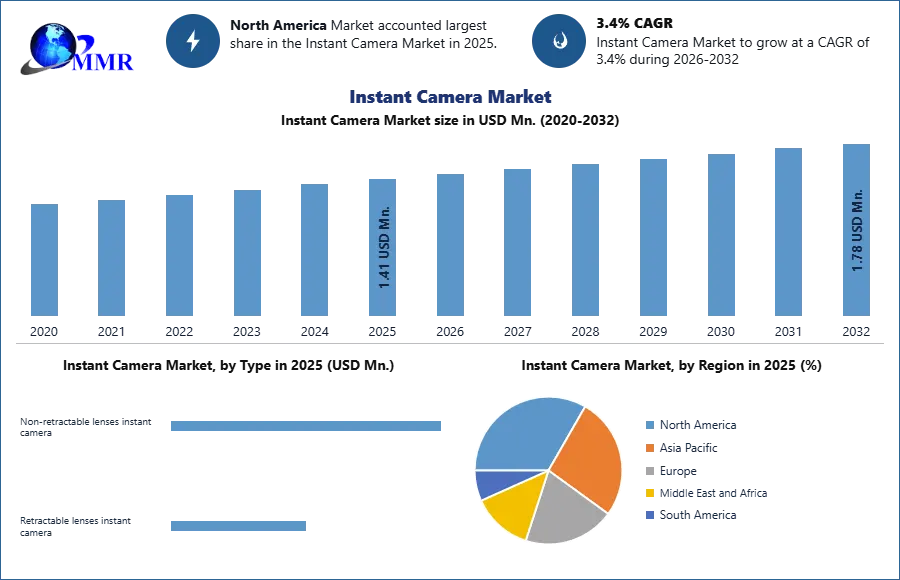
Instant Camera Market
In a world of endless digital images, physical prints become rare, with Gen Z redefining instant cameras as tools for tangible, meaningful memories.
"The instant camera market proves permanence is a premium. When every photo is a file, a print is a $1.78B statement," says Maximize Market Research.”
ROCKVILLE , MD, UNITED STATES, April 20, 2026 /EINPresswire.com/ -- PRINT OR IT DID NOT HAPPEN: How a USD 1.78 Billion Analog Comeback Is Outselling Every Digital Trend— Maximize Market Research
Instant Camera Market Size, valued at USD 1.41 Billion in 2025, is projected to reach a USD 1.78 Billion valuation by 2032. This growth reflects a surging Instant Camera Market Demand among the digital generation, who value the "premium scarcity" of physical prints. Currently, retractable lens models dominate with a 78% share, while North America generates 42.61% of the total Instant Camera Market Revenue. Driven by Asia-Pacific’s vibrant youth culture, industry leaders like Fujifilm and Polaroid have successfully repositioned these devices as essential lifestyle tools, ensuring a steady 3.4% CAGR through the forecast period.
Get Full PDF Sample Copy of Report: (Including Full TOC, List of Tables & Figures, Chart) @ https://www.maximizemarketresearch.com/request-sample/83298/
WHY IS GEN Z BUYING CAMERAS WITH FILM? Three Non-Reversible Forces Fuelling the Instant Camera Market
Three forces are driving instant camera market growth beyond cyclical nostalgia. First, Gen Z’s “photo dump” culture on TikTok and Instagram has elevated the physical print from sentimental keepsake to social-signal lifestyle accessory, a genuine demand structural shift, not cyclical trend. Second, analog-digital hybrid cameras from Fujifilm (Instax SQUARE SQ20) and Polaroid’s I-2 have bridged the gap: users can edit digitally before printing and use the camera as a portable printer for smartphone photos via Bluetooth, expanding the addressable use case beyond point-and-shoot into a creative production tool. Third, tourism and experiential gifting are non-discretionary demand engines: international tourist arrivals grew 4% to 1.5 billion in 2024, with instant cameras consistently ranking in the top-10 travel companion electronics globally.
CAN SMARTPHONES KILL THIS MARKET? The Two Real Friction Points Slowing Instant Camera Growth
The primary structural constraint is instant film supply chain vulnerability: self-developing film production is concentrated among two manufacturers globally, creating pricing power limitations and supply disruption risk that digital alternatives do not carry. Film cartridge costs of USD 0.80–1.50 per print create a recurring expenditure burden that limits heavy-use adoption in price-sensitive demographics. Smartphone camera advancement , particularly computational photography achieving professional-grade results , remains the category’s primary substitution threat, particularly for casual photographers who previously represented the market’s volume base.
45 BILLION VIEWS AND ZERO AD SPEND: How TikTok and Instagram Became Free Sales Engines for Instant Cameras
The social media flywheel, driven by billions of views for analog aesthetics and photo dump formats, serves as the primary marketing infrastructure for instant cameras. This organic demand fuels Fujifilm’s 10 million annual unit sales, as creators validate the aesthetic to millions of followers at zero cost. Parallel to this, the commercial segment,led by Polaroid’s event partnerships,commands a 70.8% share in key regions. By leveraging branded guestbooks and premium corporate experiences, manufacturers have turned events into high-revenue channels that successfully bridge the gap between tangible memories and digital influence.
FOLLOW THE MONEY: Which Lens Type, Channel, and Use Case Is Capturing Instant Camera Demand in 2026
The Global Instant Camera Market is segmented by type, distribution channel, and application. By type, retractable lens cameras dominate at 78% market share due to compact form factor, superior zoom capability, and CMOS sensor integration enabling hybrid digital features. Non-retractable lens cameras retain the 22% share driven by the entry-level gifting segment. By distribution channel, online retail accounts for over 55% of global distribution, driven by influencer-led DTC purchasing and social media discovery. By application, individual use leads in unit volume while commercial use leads in revenue-per-transaction, driven by events, hospitality, and branded giveaway applications.
By Type
Retractable Lenses Instant Camera
Non-Retractable Lenses Instant Camera
By Distribution Channel
Offline
Online
By Application
Commercial Use
Individual Use
Get Full PDF Sample Copy of Report: (Including Full TOC, List of Tables & Figures, Chart) @ https://www.maximizemarketresearch.com/request-sample/83298/
TWO COMPLETELY DIFFERENT RACES: North America Wins on Premium Value, Asia-Pacific Wins on Sheer Volume
North America: Dominant Market Leader North America maintains the largest market share, fueled by high disposable incomes and a robust gifting culture. Fujifilm and Polaroid dominate this region, particularly during Q4 peak seasons. The U.S. and Canada remain core hubs where instant cameras have successfully transitioned from basic electronics to high-demand fashion accessories, driven by consistent consumer spending and brand loyalty.
Asia-Pacific: Fastest-Growing Region Asia-Pacific is the market’s primary volume engine, with Fujifilm commanding over 70% of shipments. Japan’s street photography heritage and the viral success of the Instax Mini 12 in South Korea and Taiwan drive massive growth. India’s expanding youth demographic and China’s obsession with retro aesthetics are creating a first-generation consumer base at an unprecedented scale through 2032.
Europe: Sustainability-Led Premium Market Europe holds a significant value share, defined by a preference for high-end hybrid models. Consumers here prioritize "analog charm" paired with digital efficiency. Crucially, the European market is shifting toward sustainability, with rising demand for eco-friendly designs and recycled materials. This creates a lucrative premium niche for manufacturers who integrate green credentials into their camera and film packaging.
FOUR REASONS THE INSTANT CAMERA MARKET WILL NOT LOOK THE SAME BY 2032
1. Digital-Analog Hybridization: Fujifilm’s "edit-before-print" model allows users to apply filters digitally before committing to film. Bluetooth-enabled smartphone-to-print workflows have transformed these devices into portable printers, significantly increasing film consumption rates.
2. Gen Z "Photo Dump" Culture: With 45 billion views for #photodump in 2024, physical prints have become vital social signals. Gen Z treats tangible, imperfect photos as an aesthetic counternarrative to ephemeral digital feeds, driving massive organic demand.
3. Commercial Premiumization: The hospitality and events sector is the highest-revenue segment. Branded guestbooks and photo-booth experiences with custom overlays command 3–5x the revenue of retail sales while generating valuable direct-to-brand consumer data.
4. ZINK Technology: Zero Ink (ZINK) paper eliminates cartridges, enabling ultra-compact formats. Brands like HP and Kodak use ZINK to capture the sub-$100 market, expanding accessibility below traditional price floors.
THE ANALOG ARMS RACE: How Fujifilm, Polaroid, and a New Wave of Challengers Are Dividing the Market
The market is highly concentrated, with Fujifilm and Polaroid controlling over 65% of global shipments. Fujifilm dominates Asia-Pacific through tiered pricing and format variety, while Polaroid leverages retro-equity and Bluetooth connectivity. Competitors like Leica and Kodak target premium niches. Fujifilm’s 2021 Instax SQUARE SQ20 launch revolutionized the industry by introducing the hybrid architecture (digital processing with analog output) that now defines the market's fastest-growing segment, securing their long-term technological first-mover advantage.
Instant Camera Market Key Players:
Fujifilm
Polaroid
Lomographische AG
Leica
Kodak
HP Sprocket
Canon
Plr Ip Holdings
Mint Camera
The Impossible Project
Rolleiflex
Sony
Zink Holdings LLC
Kodak Alaris
Get access to the full description of the report @ https://www.maximizemarketresearch.com/market-report/global-instant-camera-market/83298/
Key Recent Developments in the Global Instant Camera Market
2021: Fujifilm’s Instax SQUARE SQ20 launch defined the hybrid template, adding digital processing and filters to the analog experience, permanently expanding the market’s use cases.
2024: Global Instax sales topped 10 million units. Driven by the #instaxphotography viral flywheel (2.3B views), the Mini 12 dominated key Asian markets as a lifestyle staple.
2025: Polaroid’s event-management partnerships established a high-value B2B model, utilizing branded cameras and custom border filters for premium corporate deployments.
2024, Travel Impact: Global tourism’s recovery to 1.5 billion arrivals provided a structural uplift, cementing instant cameras as essential travel-companion tools rather than cyclical trends.
E-Commerce Shift: By 2025, online channels accounted for 55% of Asia-Pacific sales. Influencer-led platforms like TikTok Shop and Lazada now serve as the primary distribution engines for the next-gen consumer base.
FAQs: Global Instant Camera Market
Q1: What drives the 3.4% CAGR in the Instant Camera Market? Ans: Growth is fueled by a shift from photography utility to "social currency." Consumers prioritize tactile, analog imperfection over digital perfection, making these cameras essential lifestyle accessories.
Q2: How does Gen Z influence this market? Ans: Gen Z’s "photo dump" culture and desire for authenticity create a social media flywheel. Viral organic demand on platforms like TikTok acts as a permanent structural demand engine.
Q3: Can smartphones displace instant cameras? Ans: No. Smartphones offer digital precision, but the instant camera market thrives on the unique, tangible experience of physical film that digital devices cannot replicate.
Q4: Which brands dominate the competitive landscape? Ans: Fujifilm’s product innovation and Polaroid’s heritage resurgence anchor the market. Their success is rooted in cultural meaning rather than just technical specifications.
Q5: What is the role of hybrid camera technology? Ans: Hybrid systems combine digital sensors with analog printing, allowing "select-before-print" functionality. This innovation solves film-waste concerns while maintaining the tactile appeal of physical photos.
Analyst Perspective
Analysts identify the 3.4% CAGR as sustainable because instant cameras have pivoted from utility to lifestyle social currency. This "analog imperfection" creates a unique value proposition smartphones cannot displace. Driven by a social media flywheel and Gen Z creative culture, the market thrives on viral organic demand. While Asia-Pacific leads in volume, North America commands a value premium, securing the category's longevity through 2032 as a culturally anchored essential.
Related Reports
Digital Camera Market https://www.maximizemarketresearch.com/market-report/global-digital-camera-market/54990/
Digital Camera Market by Type (Mirrorless, DSLR, Compact), Application (Photography, Filmmaking), Distribution Channel, and Region Global Forecast to 2032
Action Camera Market https://www.maximizemarketresearch.com/market-report/global-action-camera-market/100070/
Action Camera Market by Type, Resolution, Application (Sports, Travel, Adventure), Distribution Channel, and Region Global Forecast to 2032
Doorbell Camera Market https://www.maximizemarketresearch.com/market-report/doorbell-camera-market/201356/
Doorbell Camera Market by Type (Wired, Wireless), Application (Residential, Commercial), Resolution, Distribution Channel, and Region Global Forecast to 2032
Photography Accessories Market https://www.maximizemarketresearch.com/market-report/photography-accessories-market/210076/
Photography Accessories Market by Product Type (Bags, Tripods, Filters, Film), Distribution Channel, and Region, Global Forecast to 2032
Portable Photo Printer Market https://www.maximizemarketresearch.com/market-report/portable-photo-printer-market/173690/
Portable Photo Printer Market by Technology (Inkjet, Thermal, ZINK), Application (Consumer, Commercial), Distribution Channel, and Region, Global Forecast to 2032
Top Reports:
Global Resuscitation Masks Market
Magnesite Market
About Maximize Market Research Pvt. Ltd.
Maximize Market Research is a premier global consulting firm headquartered in Pune, India. Serving clients across 45+ countries, MMR delivers high-granularity market intelligence across Consumer Goods, Electronics, and Technology, empowering enterprises with data-driven insights to make strategic decisions with confidence.
Domain Focus
This report falls under Maximize Market Research’s Consumer Goods and Services domain, spanning instant cameras, analog photography, portable photo printing, and lifestyle imaging accessories across 45+ countries, delivering intelligence brand managers, retail strategists, and consumer electronics investors need to navigate the evolving global instant photography market with precision through 2032.
Lumawant Godage
MAXIMIZE MARKET RESEARCH PVT. LTD.
+91 96073 65656
akash.r@maximizemarketresearch.com
Visit us on social media:
LinkedIn
Instagram
Facebook
X
Legal Disclaimer:
EIN Presswire provides this news content "as is" without warranty of any kind. We do not accept any responsibility or liability for the accuracy, content, images, videos, licenses, completeness, legality, or reliability of the information contained in this article. If you have any complaints or copyright issues related to this article, kindly contact the author above.
