

Smart Home Devices Market Size worth USD 250.92 Billion by 2032, Exclusive Report by Maximize Market Research
Smart Home Devices Market
Explore detailed market data, figures, and segmentation on smart homes, IoT devices, and home automation systems across global regions.
Breaking Smart Home Devices news reshapes connected living; Maximize Market Research drives tomorrow’s intelligent ecosystem shift.”
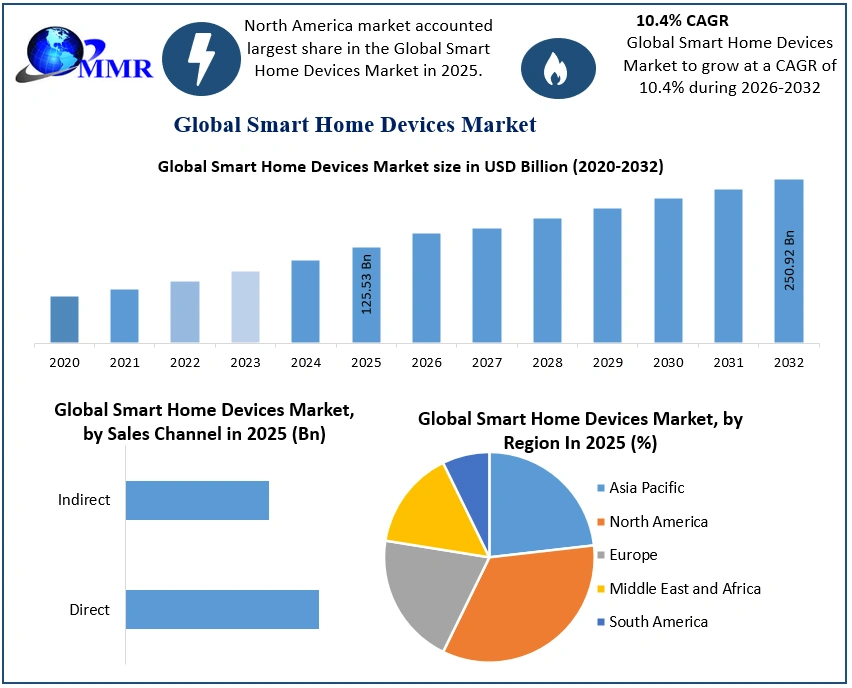
ROCKVILLE , MD, UNITED STATES, April 10, 2026 /EINPresswire.com/ -- Maximize Market Research, the Smart Home Devices Market is projected to grow from USD 125.53 billion in 2025 to USD 250.92 billion by 2032, at a CAGR of 10.4% during the forecast period (2026–2032).— Maximize Market Research
Get Full PDF Sample Copy of Report: (Including Full TOC, List of Tables & Figures, Chart) @ https://www.maximizemarketresearch.com/request-sample/145908/
Smart Home Devices Market Size & Forecast
Market Size (2025): USD 125.53 Billion
Projected Market Size (2032): USD 250.92 Billion
CAGR (2026–2032): 10.4%
Base Year: 2025
Forecast Period: 2026–2032
Smart Home Devices Market Trends & Insights
Smart Home Devices Market is experiencing accelerated transformation as residential environments shift from device-based automation to fully integrated intelligent living ecosystems. The market is witnessing strong adoption across smart security systems, energy management devices, voice-assisted ecosystems, and AI-enabled home control platforms.
Growth is being driven by the convergence of Internet of Things (IoT), artificial intelligence, edge computing, and cloud-based automation platforms, enabling real-time decision-making and adaptive home environments.
The increasing penetration of multi-device connected ecosystems, including smart speakers, thermostats, lighting systems, surveillance devices, and connected appliances, is reshaping consumer expectations toward predictive and self-learning home automation systems.
“AI-driven contextual automation is redefining the next phase of smart home intelligence.”
AI-enabled smart home systems are emerging as the fastest-evolving segment within the market, where devices no longer function as isolated tools but as part of a context-aware automation network. These systems analyze behavioral patterns such as occupancy, movement, energy consumption, and user preferences to dynamically optimize home environments.
“Energy-intelligent smart home ecosystems are gaining traction across urban residential infrastructure.”
Smart home devices integrated with real-time energy monitoring and adaptive consumption systems are gaining strong adoption, particularly in urban residential clusters. These systems enable automated optimization of HVAC, lighting, and appliances based on energy pricing fluctuations and consumption behavior analytics.
AI-Powered Smart Home Ecosystems & Matter Protocol Revolution Driving the Future of Connected Living Market Growth
Rising Demand for AI-enabled Connected Living Ecosystems: The rapid adoption of AI-powered smart home ecosystems integrated with IoT-enabled infrastructure is a major growth accelerator. Consumers are increasingly shifting toward fully connected residential environments, where devices communicate seamlessly to improve convenience, safety, and energy efficiency.
Expansion of Multi-device Interoperability Standards: The introduction and adoption of unified interoperability protocols such as Matter are enabling cross-brand compatibility across smart home ecosystems. This is reducing fragmentation and improving the scalability of multi-device installations across residential environments.
Data Privacy Risks and Cloud Dependency Challenges Reshaping the Smart Home Devices Market Growth Outlook
Data Privacy and Behavioral Analytics Risk Constraints: The market faces growing concerns regarding behavioral data exposure, cloud dependency risks, and unauthorized access to connected home networks. Smart home devices continuously collect sensitive information, including occupancy patterns, user routines, and energy consumption behavior, increasing exposure to cybersecurity threats.
High Dependency on Cloud-based Automation Infrastructure: Many smart home ecosystems rely heavily on cloud-based processing and remote control systems, making them vulnerable to service interruptions and latency issues. This dependency can disrupt critical functions such as security systems, smart locks, and automated environmental controls.
Smart Home Devices Market Segmentation by Security, AI Software, and Connected Ecosystems Driving Global Growth Trends
Smart Home Devices Market is segmented into Security & Access Control, Lighting Control, HVAC Control, Smart Speakers, Smart Kitchen, and Smart Furniture, with Security & Access Control emerging as the dominant segment due to rising demand for AI-enabled surveillance and connected home safety solutions. Indirect sales channels lead market distribution, driven by e-commerce expansion and telecom bundling, while behavioral software dominates services, enabling predictive automation, energy optimization, and AI-powered connected living ecosystems globally.
By Product Type
Lighting Control
Security & Access Control
HVAC Control
Smart Speaker
Smart Kitchen
Smart Furniture
By Sales Channel
Direct
Indirect
By Software & Services
Behavioral
Proactive
Get Full PDF Sample Copy of Report: (Including Full TOC, List of Tables & Figures, Chart) @ https://www.maximizemarketresearch.com/request-sample/145908/
North America Leads While Asia Pacific Accelerates: Regional Growth Dynamics in the Smart Home Devices Market
North America leads the Smart Home Devices Market due to high IoT penetration, strong smart home ecosystem adoption, and robust demand for AI-enabled security and automation systems, while Asia Pacific emerges as the fastest-growing region driven by smart city expansion, urbanization, and rising connected device usage. Europe follows with steady adoption of energy-efficient solutions, whereas Latin America and MEA show gradual growth supported by digital infrastructure development and increasing smart home awareness.
Honeywell, Siemens, Johnson Controls & Schneider Electric Drive Smart Home Devices Market Transformation Through AI, IoT and Cloud Innovations
In February 23, 2026, Honeywell amended its USD 1.68 billion acquisition of Johnson Matthey’s Catalyst Technologies to accelerate high-growth building automation and sustainability software integration.
On January 29, 2026, Siemens solidified its ADMARES partnership, launching an AI-driven "Digital Twin" smart factory to mass-produce modular homes with natively integrated IoT sensors.
Unveiled on January 14, 2026, at the AHR Expo, the Metasys 15.0 update revolutionizes interoperability by supporting 1,000 IP devices per server for seamless residential-to-commercial connectivity.
Expanding its "Electricity 4.0" initiative throughout 2025, Schneider Electric launched the PrismaSeT Active switchboard, the industry’s first cloud-native energy management solution for intelligent, sustainable home ecosystems.
Smart Home Devices Market, Key Players:
Honeywell (US)
Siemens (Germany)
Johnson Controls (Ireland)
Schneider Electric (France)
ASSA ABLOY (Sweden)
Amazon (US)
Apple (US)
ADT (US)
ABB (Switzerland)
Robert Bosch (Germany
Sony (Japan)
Samsung Electronics (South Korea)
Crestron Electronics (US)
Legrand (France)
Others
Get access to the full description of the report @ https://www.maximizemarketresearch.com/market-report/smart-home-devices-market/145908/
FAQs:
What are the key factors driving the growth of the Smart Home Devices Market during 2026–2032?
Ans: Smart Home Devices Market is primarily driven by the integration of AI-enabled contextual automation, IoT-enabled ecosystems, and cloud-based smart infrastructure, enabling predictive home management and real-time decision-making. Rising adoption of smart security systems, energy-efficient automation, and voice-assisted platforms is further accelerating demand across residential sectors globally.
Which region is expected to dominate the Smart Home Devices Market and why?
Ans: North America is expected to dominate the Smart Home Devices Market due to high IoT penetration, strong adoption of AI-powered smart ecosystems, and advanced home automation infrastructure. Meanwhile, Asia Pacific is emerging as the fastest-growing region, supported by rapid urbanization, smart city initiatives, and increasing penetration of connected devices and smartphones.
How are recent technological advancements impacting the Smart Home Devices Market?
Ans: Recent advancements such as AI-driven digital automation, Matter interoperability standards, and cloud-native energy management systems are transforming the Smart Home Devices Market. Innovations from key players like Honeywell, Siemens, and Schneider Electric are enabling seamless device connectivity, predictive analytics, and scalable smart building ecosystems, significantly enhancing efficiency and user experience.
Analyst Perspective:
From an analyst perspective, the Smart Home Devices sector is poised for strong expansion driven by AI-enabled ecosystems, IoT integration, and cloud-based automation. Competitive intensity among key players is accelerating innovation, M&A activity, and platform upgrades. Regional adoption is led by North America and Asia Pacific, signaling robust long-term investment potential and strategic digital transformation across connected living solutions.
Related Reports:
Smart Wiring Devices Market: https://www.maximizemarketresearch.com/market-report/smart-wiring-devices-market/186393/
Smart Wiring Devices Market by Product Type (Switches, Dimmers, Outlets, Thermostats, Controllers), End Use (Residential, Commercial, Industrial) and Region – Global Forecast to 2032
Smart Garage Door Controller Market: https://www.maximizemarketresearch.com/market-report/smart-garage-door-controller-market/217451/
Smart Garage Door Controller Market by Type (Wi-Fi Based, Bluetooth Based), Distribution Channel (Online, Offline), Application (Residential, Commercial), and Region – Global Forecast to 2032
Home Improvement Market: https://www.maximizemarketresearch.com/market-report/home-improvement-market/122436/
Home Improvement Market by Project (DIY, DIFM), End Use (Kitchen Improvements, Bathroom Improvements, Exterior Replacements, Interior Replacements, System Upgrades), Region - Global Forecast to 2032
Smart Doorbell Market: https://www.maximizemarketresearch.com/market-report/global-smart-doorbell-market/63180/
Smart Doorbell Market by Product Type (Wired, Wireless), End User (Residential, Commercial), Connectivity, Distribution Channel, and Region – Global Forecast to 2032
Top Reports:
Australia Quenched & Tempered Steel Market
Plastic Pipe Fitting Market
About Maximize Market Research:
Maximize Market Research delivers focused insights on the Smart Home Devices sector, a rapidly evolving domain within the Semiconductor ecosystem. Our analysis supports global clients with data-driven intelligence across IoT-enabled automation, AI-driven home systems, and connected infrastructure. Serving Fortune 500 companies, we enable strategic decision-making across IT & telecom, healthcare, and electronics industries with growth-oriented research and consulting excellence.
Lumawant Godage
MAXIMIZE MARKET RESEARCH PVT. LTD.
+91 96073 65656
akash.r@maximizemarketresearch.com
Visit us on social media:
LinkedIn
Instagram
Facebook
X
Legal Disclaimer:
EIN Presswire provides this news content "as is" without warranty of any kind. We do not accept any responsibility or liability for the accuracy, content, images, videos, licenses, completeness, legality, or reliability of the information contained in this article. If you have any complaints or copyright issues related to this article, kindly contact the author above.
