

Japan’s Healthcare Analytics Surge: Innovation at the Speed of AI | Healthcare Analytics Market to Hit US$15.10B by 2033
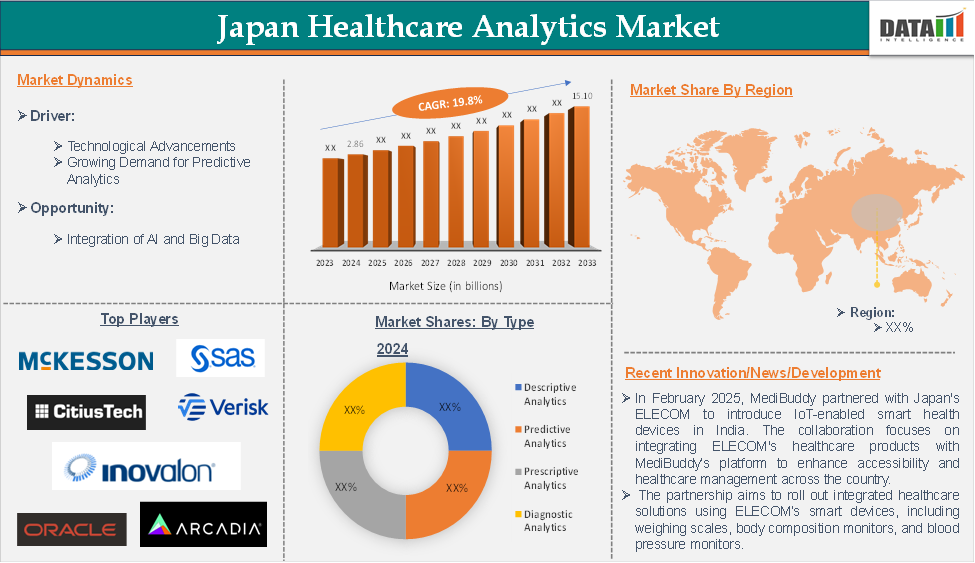
Japan Healthcare Analytics Market
Japan’s data-driven healthcare revolution is enabling predictive diagnostics, cost optimization, and personalized treatment at scale.
As Japan’s elderly population grows, healthcare analytics becomes the backbone of smarter hospitals, efficient workflows, and data-driven clinical excellence nationwide”
OSAKA, OSAKA, JAPAN, February 11, 2026 /EINPresswire.com/ -- According to DataM Intelligence, the Japan healthcare analytics market reached US$ 2.40 billion in 2024 and is expected to reach US$ 15.10 billion by 2033, growing at a strong CAGR of 19.8% during the forecast period (2025–2033). This impressive growth trajectory is driven by expanding electronic health record (EHR) adoption, increased government investments in digital health infrastructure, rising demand for predictive analytics in chronic disease management, and the integration of AI-powered clinical decision support systems. The services segment currently leads the market due to high demand for implementation, integration, and consulting services, while hospitals remain the dominant end-user segment owing to large-scale patient data generation and operational analytics requirements. Geographically, metropolitan regions such as Tokyo and Osaka are at the forefront of adoption, supported by advanced healthcare infrastructure and strong digital readiness.— DataM Intelligence
The Japan healthcare analytics market is rapidly evolving as the country confronts one of the most significant demographic transitions in the world. With more than 22 million people aged 75 and above and a steadily shrinking working-age population, Japan’s healthcare system is under mounting pressure to improve efficiency, reduce costs, and deliver personalized, high-quality care. Healthcare analytics encompassing predictive analytics, prescriptive analytics, and descriptive analytics has emerged as a strategic solution to manage this complexity. By leveraging big data in healthcare, artificial intelligence (AI), machine learning, and cloud computing, providers and payers are transforming raw clinical and administrative data into actionable insights that improve patient outcomes and optimize operations.
Get a Exclusive Sample PDF Of This Report (Get Higher Priority for Corporate Email ID):- https://www.datamintelligence.com/download-sample/japan-healthcare-analytics-market
Key Highlights from the Report:
➤ The Japan healthcare analytics market is witnessing strong growth driven by aging demographics and rising healthcare expenditure.
➤ Predictive analytics is gaining traction for early disease detection and chronic disease management.
➤ Hospitals remain the largest end-user segment due to increasing EHR adoption and demand for operational efficiency.
➤ Cloud-based healthcare analytics platforms are expanding rapidly, enabling scalable and cost-effective data management.
➤ Government initiatives promoting digital transformation in healthcare are accelerating analytics implementation nationwide.
➤ AI-powered analytics tools are improving clinical decision support and patient outcome tracking.
Recent Developments – Japan Healthcare Analytics Market:
September 2025: Japanese technology companies and medical institutions expanded collaborations focused on real-world data (RWD) and electronic health record (EHR) analytics to advance precision medicine and strengthen clinical research capabilities.
August 2025: Healthcare analytics providers enhanced platform capabilities with improved data security, interoperability, and regulatory-compliance features to align with Japan’s stringent healthcare data protection regulations.
June 2025: SoftBank Group entered a joint venture with Tempus AI to leverage artificial intelligence for analyzing medical data, supporting personalized treatment recommendations and advanced predictive healthcare insights.
February 2025: TriNetX and Fujitsu established TriNetX Japan K.K., a dedicated entity focused on utilizing anonymized EHR datasets to accelerate clinical trial recruitment, optimize drug development timelines, and improve healthcare analytics services nationwide.
Mergers & Acquisitions – Japan Healthcare Analytics Market:
2025: Fujitsu Healthcare strengthened its analytics portfolio by acquiring a domestic AI-based medical data analytics startup, enhancing predictive modeling, population health management, and hospital workflow optimization capabilities.
2025: NEC Corporation expanded its healthcare analytics solutions through the acquisition of a clinical AI and real-world evidence (RWE) platform, advancing disease prediction, patient stratification, and clinical decision support systems.
2025: A Japanese HealthTech consortium pursued strategic acquisitions of AI-driven diagnostic and claims analytics startups to meet the growing demand for data-driven healthcare services in the country’s aging population.
June 2025: Major investment funding rounds supported expansion and potential consolidation activities among leading healthcare analytics firms, enabling product innovation and regional market penetration.
Buy Now & Unlock 360° Market Intelligence: https://www.datamintelligence.com/buy-now-page?report=japan-healthcare-analytics-market
Company Insights:
The competitive landscape of the Japan healthcare analytics market includes global technology leaders and domestic innovators driving digital transformation.
MCKESSON CORPORATION
Inovalon.
CitiusTech Inc
Arcadia Solutions, LLC.
IBM
SAS Institute Inc.
Verisk Analytics, Inc.
Oracle
Regional Overview: Japan Healthcare Analytics Adoption:
The adoption of healthcare analytics in Japan varies significantly across regions, shaped by differences in healthcare infrastructure, digital maturity, population density, and government-backed innovation initiatives. While metropolitan regions lead in advanced analytics deployment and AI integration, rural areas are increasingly leveraging analytics to strengthen remote care delivery and elderly health management. Below is a comprehensive regional perspective on healthcare data analytics adoption across Japan.
Kanto Region (Tokyo & Surrounding Prefectures)\
The Kanto region, which includes Tokyo, Yokohama, and Chiba, represents the largest and most advanced market for healthcare analytics in Japan. As the country’s economic and technological hub, Kanto benefits from a dense concentration of tertiary hospitals, academic medical centers, pharmaceutical companies, and health technology startups. These institutions generate vast volumes of clinical and operational data, creating a strong foundation for advanced analytics integration.
Smart hospitals in Tokyo are actively deploying AI-powered clinical decision support systems, predictive analytics for disease risk assessment, and operational analytics platforms to optimize patient flow and resource allocation. Telemedicine and remote patient monitoring solutions are also expanding rapidly, particularly in response to Japan’s aging population and the need for continuous chronic disease management. With strong digital infrastructure and high healthcare IT investment, Kanto stands as the innovation leader and highest revenue-generating region in the Japan healthcare analytics market.
Kansai Region (Osaka, Kyoto, Hyogo)
The Kansai region, encompassing Osaka, Kyoto, and Hyogo, is a powerful secondary hub for healthcare analytics adoption. Known for its strong academic and medical research ecosystem, Kansai houses leading university hospitals and biotechnology research centers that actively integrate analytics into imaging diagnostics, precision medicine, and clinical workflow optimization.
Hospitals in Osaka and Kyoto are increasingly utilizing predictive risk scoring models to manage chronic diseases such as diabetes, cardiovascular conditions, and cancer. Advanced imaging analytics and AI-based radiology tools are also gaining traction in university-affiliated medical institutions. While adoption levels may not yet match those of Tokyo, Kansai’s strength lies in research-driven analytics implementation and clinical innovation. As a result, the region continues to contribute significantly to Japan’s healthcare analytics growth trajectory.
Chubu Region (Nagoya & Central Japan)
The Chubu region, centered around Nagoya, is experiencing steady growth in healthcare analytics adoption. Although not as digitally advanced as Kanto or Kansai, the region is actively pursuing smart healthcare initiatives aimed at integrating analytics into hospital data management systems. Regional healthcare providers are upgrading electronic health record systems and investing in operational analytics to enhance efficiency and cost control.
Digital transformation in Chubu is progressing at a measured pace, with hospitals gradually integrating predictive and descriptive analytics tools into existing IT infrastructure. Government-backed healthcare modernization projects are supporting this transition, ensuring gradual but consistent expansion of analytics capabilities. Overall, Chubu represents a growing market characterized by steady digitization and systematic healthcare IT upgrades.
Kyushu & Okinawa
Kyushu and Okinawa are emerging as high-growth regions for healthcare analytics, particularly in the areas of IoT-enabled healthcare and remote patient monitoring. These regions have a higher proportion of elderly residents and geographically dispersed communities, making telemedicine and connected care essential components of healthcare delivery.
Healthcare providers in Kyushu are increasingly deploying analytics platforms to track chronic disease progression, monitor vital signs remotely, and manage elderly care programs. IoT-based health devices generate continuous patient data streams that feed into analytics systems for real-time insights and preventive intervention. In some areas, the growth rate of remote health analytics adoption surpasses that of more urbanized regions, driven by the urgent need to serve aging populations efficiently. Kyushu and Okinawa therefore represent dynamic growth markets within Japan’s healthcare analytics ecosystem.
Tohoku & Hokkaido (North Japan)
In northern Japan, including Tohoku and Hokkaido, healthcare analytics adoption is primarily focused on improving access to care across dispersed and rural populations. These regions face unique geographic challenges, with significant distances between healthcare facilities and lower population density.
Analytics tools are used to support telehealth programs, remote diagnostics, and fall detection systems in eldercare settings. Population health analytics also plays a role in tracking chronic disease trends and allocating limited medical resources more effectively. While overall adoption remains slower compared to metropolitan regions, the strategic focus on remote health services ensures steady expansion of analytics applications. Digital health programs supported by regional authorities continue to strengthen adoption across North Japan.
Rest of Japan (Smaller Cities & Rural Areas)
In smaller cities and rural communities across Japan, healthcare analytics adoption is emerging gradually. Infrastructure limitations, budget constraints, and workforce shortages often restrict the deployment of advanced analytics platforms. However, remote monitoring systems and basic digital upgrades are becoming more common, especially in clinics serving aging populations.
Most adoption in these areas centers on telemedicine integration, electronic health record digitization, and simple descriptive analytics for operational tracking. While full-scale AI-driven clinical analytics may remain limited, the foundation for broader healthcare data analytics implementation is steadily being built. Over time, national digital health initiatives and cloud-based solutions are expected to accelerate adoption across these underserved regions.
Key Regional Insights at a Glance:
Overall, Kanto leads Japan in innovation and highest healthcare analytics adoption, driven by advanced AI integration and telemedicine expansion. Kansai follows as a research-intensive region with strong clinical analytics utilization. Chubu demonstrates steady growth through digitization and hospital IT modernization. Kyushu and Okinawa stand out for rapid expansion in IoT-enabled connected care and elderly health analytics. Tohoku and Hokkaido focus primarily on telehealth and remote care analytics, while the rest of Japan experiences gradual adoption supported by infrastructure improvements and remote healthcare technologies.
This regional diversity highlights how the Japan healthcare analytics market is evolving not only through metropolitan innovation but also through digital inclusion strategies that extend data-driven healthcare to rural and aging communities.
Get Customization in the report as per your requirements: https://www.datamintelligence.com/customize/japan-healthcare-analytics-market
Market Segmentation:
The Japan healthcare analytics market is segmented based on component, deployment model, application, and end-user, each contributing uniquely to the market’s expansion.
By Component:
The market is segmented into software, hardware, and services. The services segment holds a major share due to demand for implementation, integration, consulting, and maintenance. Software solutions, including AI-driven analytics and data visualization tools, are growing steadily as healthcare providers expand digital capabilities.
By Deployment:
The market includes on-premise and cloud-based solutions. Cloud adoption is rising, particularly among mid-sized hospitals, due to scalability and lower costs. However, large hospitals prefer hybrid or on-premise models to comply with Japan’s strict data regulations.
By Application:
Segments include financial, clinical, operational, and population health analytics. Clinical analytics leads, driven by predictive modeling for chronic disease management. Operational analytics is also growing to improve efficiency and address workforce shortages.
By End-User:
Hospitals dominate the market due to high patient volumes and digitization. Meanwhile, pharmaceutical and biotech firms increasingly use analytics for drug development and real-world evidence studies.
Market Dynamics:
Market Drivers
One of the primary drivers of the Japan healthcare analytics market is the country’s rapidly aging population. With nearly 30% of the population aged 65 and older, Japan faces increasing rates of chronic illnesses such as hypertension, diabetes, and cancer. Healthcare analytics enables predictive risk stratification, early diagnosis, and personalized treatment plans, reducing hospitalization rates and overall healthcare costs. Additionally, the government’s emphasis on digital transformation in healthcare, including nationwide EHR adoption and data-sharing frameworks, significantly accelerates analytics implementation. The integration of AI and machine learning technologies into clinical workflows further strengthens demand, improving diagnostic accuracy and decision-making efficiency.
Market Restraints
Despite promising growth, the market faces several constraints. Data privacy and security concerns remain significant barriers, particularly in handling sensitive patient information. Japan maintains strict healthcare data protection regulations, which can slow implementation timelines. Additionally, the high cost of advanced analytics platforms and integration complexities with legacy hospital systems pose challenges, especially for smaller institutions. A shortage of skilled data scientists and healthcare IT professionals further restricts the pace of adoption in certain regions.
Market Opportunities
Emerging opportunities lie in personalized medicine, remote patient monitoring, and value-based healthcare models. Healthcare analytics plays a crucial role in developing precision treatment strategies based on genetic, clinical, and behavioral data. The expansion of telemedicine services and wearable health devices generates vast data streams that can be analyzed for preventive care insights. Furthermore, collaborations between technology firms and healthcare providers are opening new avenues for AI-driven predictive analytics and population health management, positioning Japan as a leader in digital health innovation.
Conclusion:
The Japan healthcare analytics market is undergoing rapid transformation driven by an aging population, rising chronic diseases, and technological advancements. Analytics solutions are enabling smarter care through predictive modeling, clinical decision support, financial optimization, and population health management.
While metropolitan areas lead adoption, rural regions offer strong untapped potential, supporting growth through 2032. Companies investing in secure, scalable, and AI-powered platforms will be best positioned to benefit from Japan’s accelerating digital health evolution.
Related Reports:
Japan Digital Health Market
Japan AI in Healthcare Market
Sai Kiran
DataM Intelligence 4Market Research
+1 877-441-4866
email us here
Visit us on social media:
LinkedIn
X
Legal Disclaimer:
EIN Presswire provides this news content "as is" without warranty of any kind. We do not accept any responsibility or liability for the accuracy, content, images, videos, licenses, completeness, legality, or reliability of the information contained in this article. If you have any complaints or copyright issues related to this article, kindly contact the author above.
